A cracked driveway might seem like a cosmetic nuisance, something you glance at and shrug off until you have more time or money to deal with it. But that small crack is rarely just cosmetic. It is often a warning sign of water intrusion, structural erosion, and a cascade of related problems that can spread to your foundation, landscaping, and even the air quality inside your home. Understanding what is really happening beneath that surface damage can help you make smarter, more cost effective decisions before the problem grows.
How Small Cracks Turn Into Big Structural Problems
A hairline crack in asphalt or concrete rarely stays small. Once water finds its way into that opening, it seeps down to the base material and, when temperatures drop, expands as it freezes. Water expands by roughly 9% in volume as it turns to ice, and that repeated pressure works like a wedge, widening the crack a little more with every cycle.
This is why driveway damage tends to accelerate rather than progress at a steady pace. A crack that measures an eighth of an inch this fall can grow into a half-inch gap by spring, especially in regions that see a dozen or more freeze-thaw cycles each winter. Once water erodes the compacted gravel or soil underneath, you start seeing potholes, sunken slabs, and alligator-pattern cracking that signals the base has failed, not just the surface.
Other factors speed up the damage too. Tree roots pushing up from below, heavy vehicles parked repeatedly on the same spot, and de-icing salts that accelerate concrete spalling can all turn a cosmetic issue into a structural one within a single season.
The longer you wait, the more expensive and invasive the eventual repair becomes. A crack sealed early might cost a small fraction of what it takes to excavate and repour an entire section of driveway once the base has washed out underneath it.
Many homeowners underestimate how quickly water damage compounds once it gets below the surface. What starts as a hairline crack barely a sixteenth of an inch wide can widen dramatically within a single freeze-thaw cycle, since water expands roughly nine percent in volume when it turns to ice. Each cycle pries the crack open a little further, and within one or two winters that harmless line can grow into a network of fractures spreading outward.
A professional asphalt contractor can usually spot the early signs of subbase failure long before they are visible to an untrained eye, including soft spots, edge crumbling, and drainage pooling near the perimeter. They’ll also check for alligator-pattern cracking, which signals that the base layer beneath the asphalt has already begun to shift or lose compaction. Sounding out the surface for hollow spots and checking slope grades near downspouts are routine parts of this inspection.
Catching these issues early often means the difference between a simple patch job costing a few hundred dollars and a full driveway replacement running into the thousands. Once water undermines the subbase, the asphalt above it loses support and begins to sag, crack, and eventually crumble under the weight of vehicles. At that point, no amount of surface sealing will fix the underlying structural failure.
Why Water Drainage Around Your Home Matters More Than You Think
Cracked driveways rarely exist in isolation. In most cases, the same drainage issues causing pavement damage are also pushing water toward your home’s foundation. Poor grading, clogged gutters, and cracked concrete all funnel water in directions it was never meant to go, which can lead to basement seepage or crawlspace moisture over time.
This is where the connection to indoor air quality becomes important. Excess moisture around a foundation often works its way indoors, creating conditions that support mold growth in basements, crawlspaces, and even wall cavities. Addressing mold removal early is critical, since prolonged exposure to certain mold species has been linked to respiratory irritation and other health concerns for sensitive individuals.
What Tree Roots Are Doing Beneath the Pavement
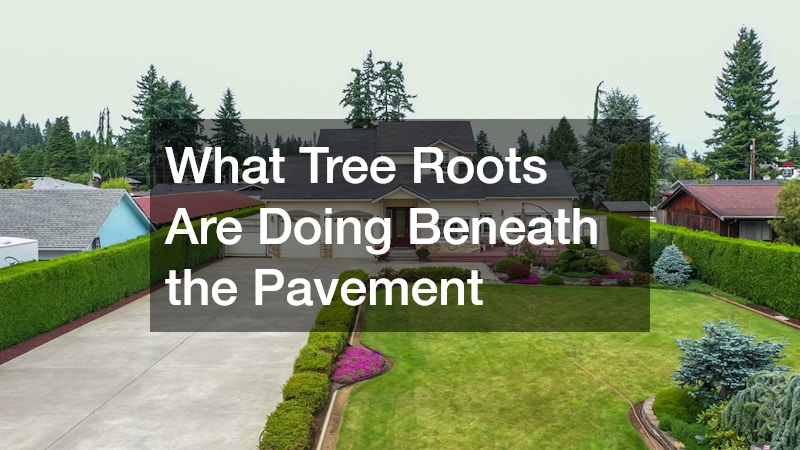
Large, mature trees are a beautiful landscaping feature, but their root systems can be surprisingly destructive when planted too close to a driveway. Species with aggressive, shallow root systems—like silver maples, willows, and sweetgums—are especially notorious offenders, often spreading roots two to three times the width of their canopy in search of water. Roots seek out moisture and will grow beneath pavement seams, gradually lifting slabs or cracking asphalt from below.
This process can take years to become visible, which is part of what makes it so deceptive. A root only needs to grow a few inches in diameter to exert enough upward pressure to crack concrete or buckle asphalt, and that pressure builds slowly and steadily rather than all at once. By the time you notice a raised slab edge or a spiderweb of cracks, the root beneath may already be several inches thick.
This kind of damage is often mistaken for simple wear and tear, when in reality it is an ongoing structural conflict between vegetation and hardscape. Unlike surface cracks caused by freeze-thaw cycles or heavy vehicle loads, root-driven damage tends to follow a distinct pattern: cracks radiating outward from a single point, or a slab that tilts upward on one side while remaining flat on the other. Recognizing this distinction matters, because patching the surface without addressing the root will only buy you a season or two before the damage returns.
Tree roots don’t need to touch your driveway to damage it. As they grow outward searching for water, they thicken over time, and that expansion exerts steady upward pressure on whatever sits above them—including several inches of concrete or asphalt. This is why a driveway crack often forms in a straight line that mirrors the path of a nearby root system rather than spreading randomly like typical settling damage.
Trees like willows, maples, and poplars are especially notorious for this because their root systems grow aggressively and close to the surface. A root as small as two or three inches in diameter can generate enough force to lift and crack a slab, and the damage tends to worsen every year the tree keeps growing.
In these situations, tree removal or selective root pruning may be necessary to stop the damage from recurring. Root pruning can work if the offending root is small and the tree’s health won’t be compromised by cutting it, but if the root is a major structural anchor, removing the tree may be the safer long-term choice.
Simply patching the surface without addressing the root cause will only lead to the same crack reappearing within a season or two. Worse, repeated patch jobs without dealing with the root can cost more cumulatively than a one-time root pruning or removal would have in the first place.
How Driveway Surface Choices Affect Long Term Durability
Not all driveway materials handle stress and weather the same way, and the material you choose has a direct impact on how often you will deal with cracking. Poured concrete is durable but prone to cracking in freeze thaw climates, while asphalt is more flexible but requires more frequent maintenance. Interlocking pavers offer a different kind of resilience, since individual units can shift slightly without the entire surface cracking the way a solid slab would.
- Concrete driveways typically last 25 to 30 years but are prone to cracking without proper joint spacing
- Asphalt driveways need resealing every 2 to 3 years to prevent water penetration
- Pavers allow for easier spot repairs since individual units can be replaced without redoing the entire surface
- Gravel driveways are the least expensive but require the most frequent regrading
- Permeable paving options can reduce water pooling and runoff around the home
Why Regular Sealcoating Extends the Life of Your Pavement
One of the most overlooked maintenance tasks for asphalt driveways is sealcoating, and skipping it is one of the fastest ways to shorten your driveway’s lifespan. Sealcoating creates a protective barrier against UV rays, oil stains, and water infiltration, all of which contribute to surface breakdown over time. Without this layer of protection, asphalt becomes brittle and far more susceptible to cracking under normal temperature fluctuations.
Most experts recommend sealcoating every two to three years, though driveways in harsher climates may need it more frequently. This relatively small investment can meaningfully delay the need for a full repaving job, which costs significantly more than routine maintenance. Think of it as similar to changing the oil in your car, a small recurring cost that prevents a much larger expense down the road.
How Foundation Moisture Problems Spread Indoors
When driveway and yard drainage issues push water toward your home, the effects are not always immediately visible from outside. Moisture can seep into basement walls, crawlspaces, and even work its way up into flooring materials, creating a damp environment that invites mold and mildew growth. This is particularly true for homes with older or improperly sealed siding.
If you notice bubbling paint, warped boards, or a musty smell near your home’s exterior walls, it may be time to consider siding repair service to seal off entry points for water. Addressing these vulnerabilities early prevents moisture from reaching insulation and interior drywall, where damage becomes far more expensive to fix. Many homeowners are surprised to learn that a cracked driveway and a soft spot on their siding can be part of the very same underlying drainage problem.
Why Whole Home Systems Suffer When Water Management Fails
Water problems rarely stay contained to one part of a house, and that includes systems you might not immediately associate with a driveway. Excess ground moisture can affect the efficiency of an air conditioning system by increasing indoor humidity levels, forcing the unit to work harder to maintain comfortable conditions. Over time, this added strain shortens the lifespan of expensive mechanical equipment.
Beyond climate control, water intrusion can also compromise the quality of water entering your home if it affects underground plumbing lines or well systems. In these cases, installing a water purification system can help ensure that sediment or contaminants introduced through ground shifting do not affect your household water supply. Addressing drainage issues at the source is always more effective than treating each downstream symptom individually.
How Power Outages Connect to Storm Related Property Damage
Severe weather that damages driveways and landscaping often brings down power lines or trips circuit breakers, leaving homes without electricity for extended periods. This is especially disruptive for households relying on well pumps, sump pumps, or medical equipment that requires a constant power source. When storm damage and power loss happen simultaneously, the risk of secondary water damage increases significantly.
Investing in generator installation gives homeowners a reliable backup power source during these vulnerable periods, ensuring that sump pumps and dehumidifiers keep running even when the grid goes down. This is particularly valuable for homes in areas prone to heavy storms or flooding, where every hour without power increases the risk of water related damage compounding.
What to Check Before Replacing Damaged Exterior Materials
Homeowners dealing with a cracked driveway often assume the damage is isolated, but a full exterior inspection frequently reveals related issues. Windows near ground level, for example, can develop condensation or drafts if surrounding soil has shifted due to water pooling. In older homes, this is a common sign that moisture has been an ongoing issue for longer than anyone realized.
If you notice fogging between glass panes or persistent drafts, it may be worth consulting a professional about replacement window options, since older windows are far less effective at blocking moisture and temperature fluctuations. Replacing compromised windows alongside broader drainage repairs ensures you are not solving one problem while leaving another to worsen. A comprehensive approach saves money in the long run compared to addressing issues piecemeal.
That cracked driveway is rarely an isolated issue, and treating it as one often means missing the bigger picture of what is happening around your home. From drainage and foundation health to indoor air quality and mechanical systems, small warning signs are usually connected in ways that are easy to overlook. Taking action now, starting with a proper inspection of your driveway and surrounding drainage, can save you from far more expensive repairs later. The sooner you address the root cause, the more control you have over the outcome.